Input Stems: vocals | drums (regenerated) | bass (regenerated) | guitar (regenerated) | other
Paradigm Shift: From Parallelized to Sequential
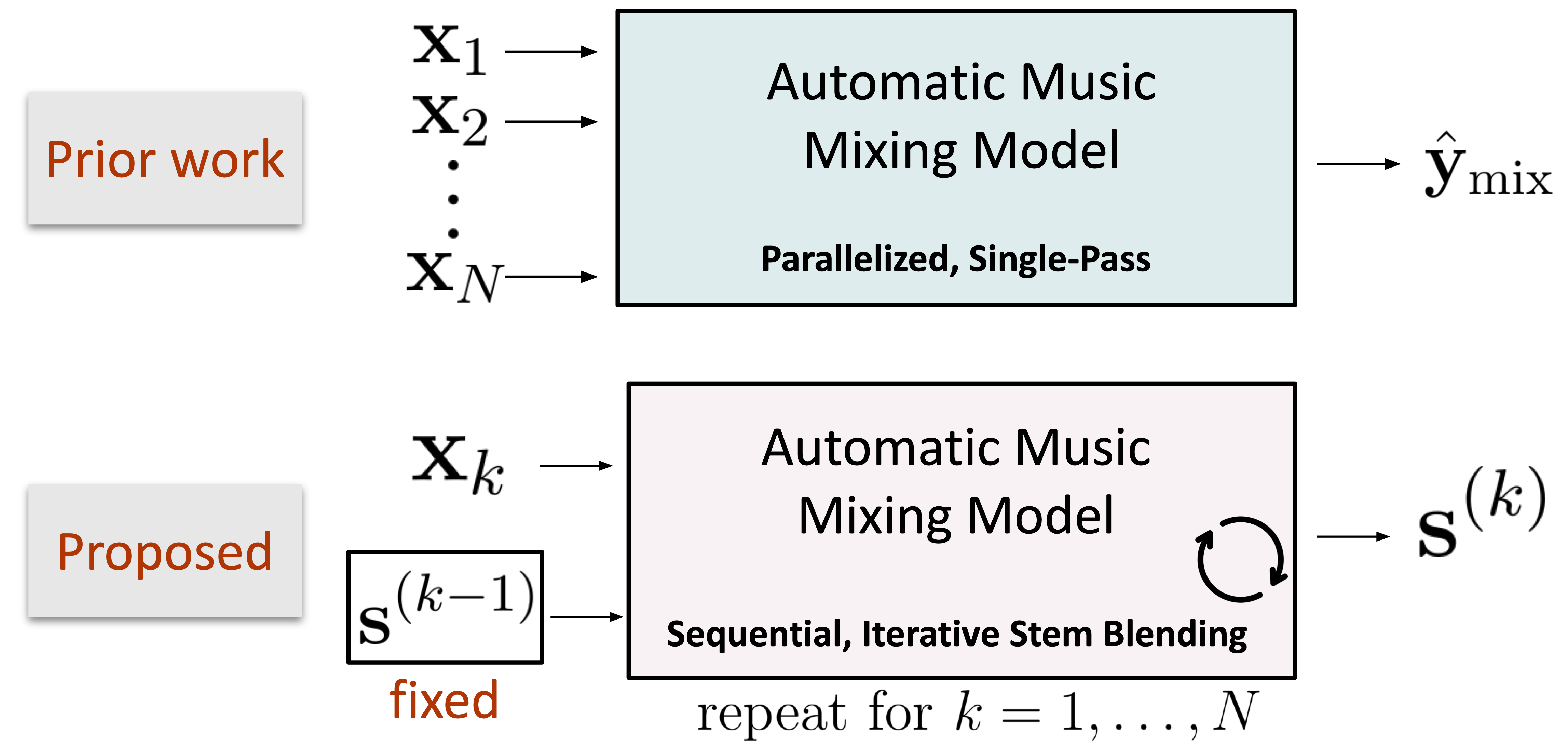
Most automatic mixing systems share the same architectural philosophy: all stems go in simultaneously, and the model produces the final mixture in a single pass. It is a clean and efficient design, but it treats mixing as a parallelized, single-pass decision rather than an iterative process.
We propose to look at this from a different angle. Just like a mix engineer listens and processes one track at a time, we blend stems one at a time, each stem integrated into a growing submix, step by step, until the final mix is complete. We call this sequential stem blending.
Challenges
Realizing sequential stem blending in practice comes with two key challenges.
Data. Existing datasets are not directly applicable to stem blending. Multitrack mixing datasets are designed for full mixture reconstruction, while source separation datasets treat the mixture as a simple sum of stems with no mixing processing, neither provides supervision for learning a single-stem blending transformation.
Modeling. Audio effects have conventionally been modeled through DSP algorithms or waveform-domain neural networks, both of which require a predefined effects chain topology specified at design time. We ask: can we learn the blending transformation implicitly, without any fixed topology constraint?
Proposed Model
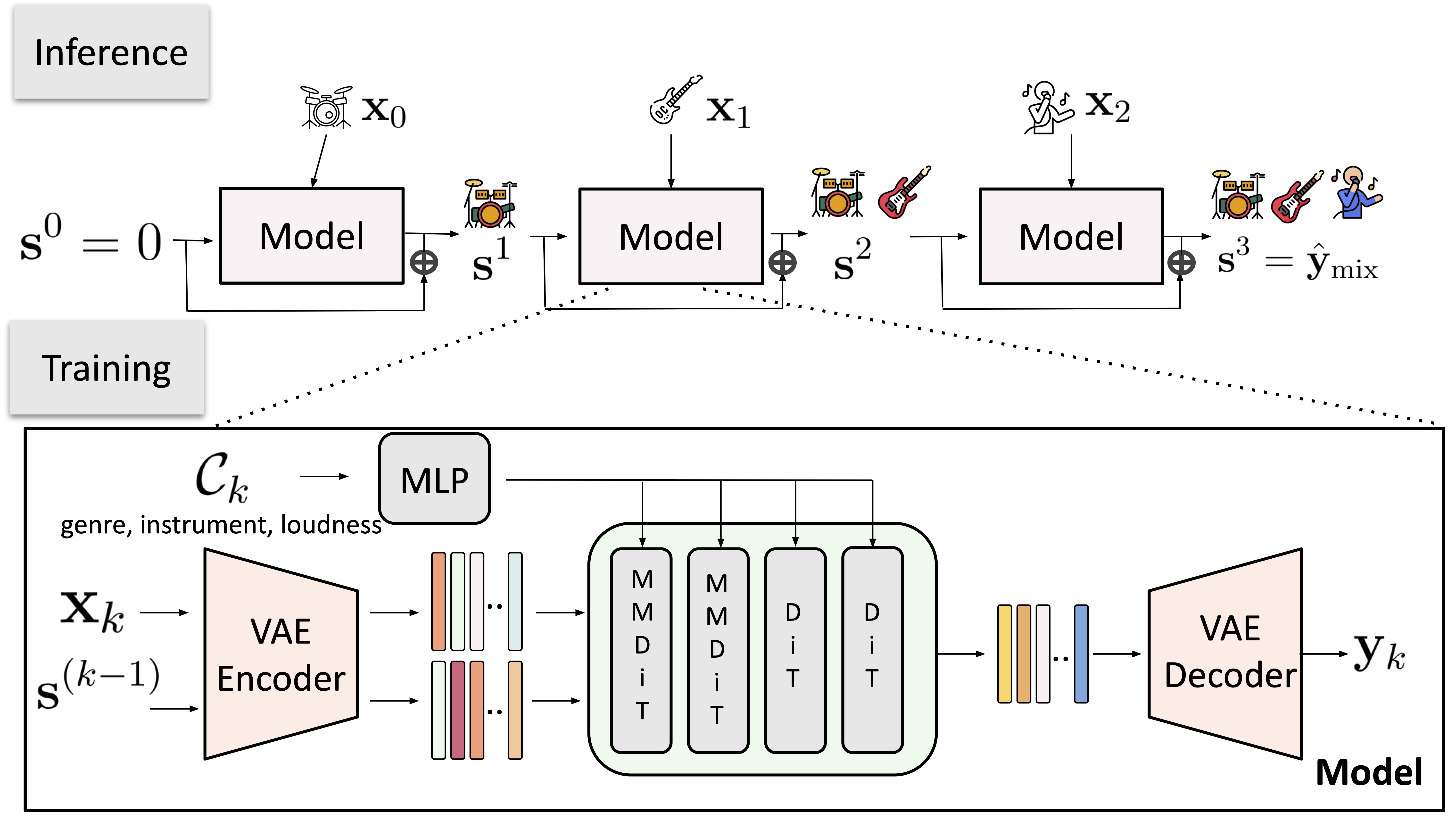
Inference (top): stems are processed sequentially, where each stem \(\mathbf{x}_k\) is blended into the current submix \(\mathbf{s}^{(k-1)}\) one at a time, with the accumulated submix growing at each step until the final mixture \(\mathbf{s}^N = \hat{\mathbf{y}}_\text{mix}\) is obtained.
Training (bottom): for each blending step, the unprocessed stem \(\mathbf{x}_k\) and the conditioning submix \(\mathbf{s}^{(k-1)}\) are encoded by a shared VAE encoder into latent sequences, where the stem latent serves as the flow source \(z_0\) and the submix latent is processed as a second modality via bidirectional joint attention in the MMDiT blocks. The meta-conditioning set \(\mathcal{C}_k\) (genre, instrument, loudness) is processed by an MLP and injected into all transformer blocks via AdaLN. The predicted latent is decoded by the VAE decoder to produce the processed stem \(\mathbf{y}_k\).
Degradation-Based Data Synthesis
Since source separation datasets only provide wet stems with no unprocessed counterpart, we simulate the unprocessed stem \(\mathbf{x}_k\) by applying degradations to the wet stem \(\mathbf{y}_k\). A key design decision here is that we do not apply random audio effects. Random EQ curves are ambiguous from a mixing perspective — a boost in a certain frequency region could equally be interpreted as valid creative processing or as a mixing problem, depending on the musical context. Instead, our degradation modes are grounded in specific, commonly observed bad mixing scenarios that a mix engineer would recognize and correct. Each mode is conditioned on the spectral content of the stem or the submix, ensuring that the degradation reflects a meaningful relationship between the stem and its context — not an arbitrary transformation. This way, the model is trained to undo degradations that have clear musical meaning, rather than learning to invert random noise.
We apply two types of degradation. The first is spectral degradation via a parametric equalizer, applied in five distinct modes:
- Masking Boost — boosts frequencies already occupied by the submix, simulating frequency masking between stems.
- Over-Cut — cuts the stem's own prominent bands, simulating over-correction that strips character from the stem.
- Low-End Mud — applies a heavy low-shelf boost and high-frequency cut, simulating a muddy, bass-heavy mix.
- Harshness — adds a narrow boost in the 2–5 kHz region, simulating an overly aggressive presence boost.
- Blend — combines submix-informed boost with stem-informed cut, simulating a general poor blend between the stem and submix.
While each mode defines a distinct degradation archetype, the actual EQ curve is stochastic within each mode. Peak filter frequencies are randomly jittered by up to ±20% around their target bands, Q factors are independently sampled per filter, and Gaussian noise is added to the gain values of both shelf and peak filters. A random gain offset is further applied to the degraded stem after EQ. Together, these sources of randomness ensure that no two training examples share the same EQ curve, even under the same degradation mode.
The second type is room reverberation, applied on top of the spectrally degraded stem. Room mode (small, large, or mixed absorption) is randomly selected, with room dimensions, source positions, and microphone positions all independently randomized within each configuration. For the mixed mode, wall absorption coefficients are further randomized per surface. This produces a wide variety of reverberant conditions, simulating stems recorded in acoustically diverse environments.
Audio Examples
The following sections demonstrate audio examples across two evaluation scenarios: stem blending and automatic music mixing. All examples are from held-out test sets not seen during training. We also include the audio samples used in our subjective listening test for reference.
Stem Blending
A single stem is blended into the remaining stems as the fixed submix. The final mixture is compared against the professionally mixed reference.
| Reference | Raw-mix | DMC | DMC† | MEGAMI | MEGAMI† | Proposed | |
|---|---|---|---|---|---|---|---|
| Sample 1 | |||||||
| Sample 2 | |||||||
| Sample 3 | |||||||
| Sample 4 |
Automatic Music Mixing
All stems are processed sequentially to produce the final mixture. We compare two ordering strategies for the proposed model: random order and domain-knowledge order.
| Reference | Raw-mix | DMC | MEGAMI | Proposed (Random) | Proposed (Domain) | |
|---|---|---|---|---|---|---|
| Sample 1 | ||||||
| Sample 2 | ||||||
| Sample 3 | ||||||
| Sample 4 |
Real-World Scenario (Subjective Listening Test)
To evaluate generalization beyond the training distribution, we test our model on stems generated by a commercial music production platform. For each of three songs, source separation is first applied to obtain five stems — vocals, drums, bass, guitar, and other — after which the drums, bass, and guitar stems are regenerated conditioned on the remaining stems as musical context. These regenerated stems are then used as input for both evaluation scenarios below.
Song 1
Stem Blending
| Raw-mix | DMC | MEGAMI | Proposed | |
|---|---|---|---|---|
| + Drums | ||||
| + Bass | ||||
| + Guitar |
Automatic Music Mixing
| Raw-mix | DMC | MEGAMI | Proposed | |
|---|---|---|---|---|
| Sample 1 | ||||
| Sample 2 | ||||
| Sample 3 |
Song 2
Input Stems: vocals | drums (regenerated) | bass (regenerated) | guitar (regenerated) | other
Stem Blending
| Raw-mix | DMC | MEGAMI | Proposed | |
|---|---|---|---|---|
| + Drums | ||||
| + Bass | ||||
| + Guitar |
Automatic Music Mixing
| Raw-mix | DMC | MEGAMI | Proposed | |
|---|---|---|---|---|
| Sample 1 | ||||
| Sample 2 | ||||
| Sample 3 |
Song 3
Input Stems: vocals | drums (regenerated) | bass (regenerated) | guitar (regenerated) | other
Stem Blending
| Raw-mix | DMC | MEGAMI | Proposed | |
|---|---|---|---|---|
| + Drums | ||||
| + Bass | ||||
| + Guitar |
Automatic Music Mixing
| Raw-mix | DMC | MEGAMI | Proposed | |
|---|---|---|---|---|
| Sample 1 | ||||
| Sample 2 | ||||
| Sample 3 |
BibTeX
BibTex Code Here